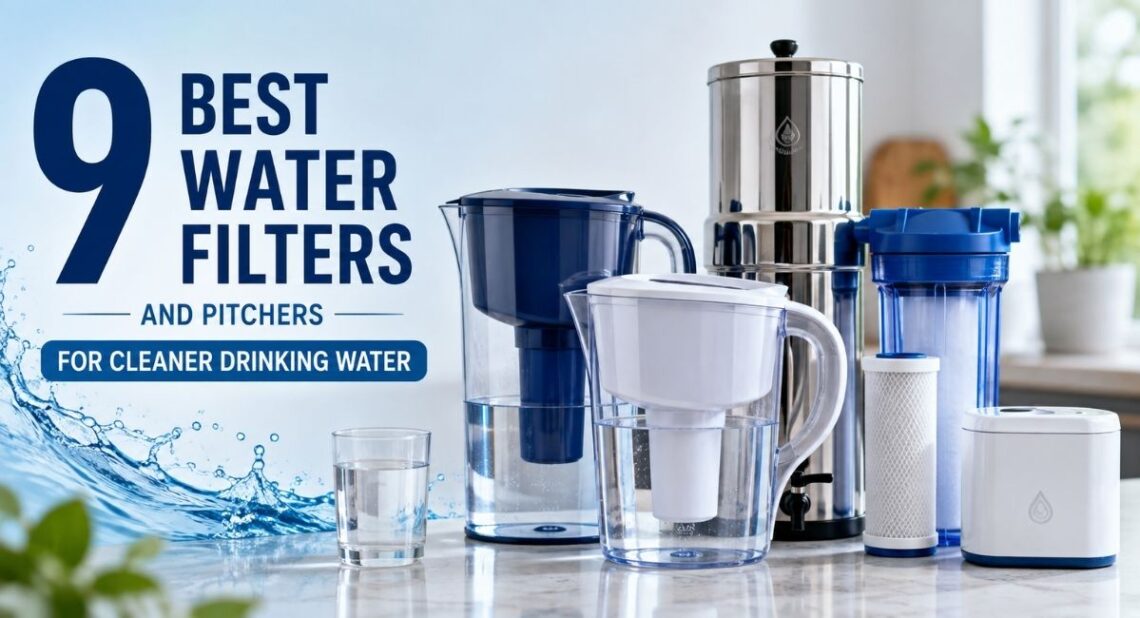
If your tap water smells strongly of chlorine, leaves white scale on your kettle, or simply tastes unpleasant, you do not need to accept it as part of everyday life. A good water filter can make a noticeable difference, but choosing one is harder than it looks.
The problem is that water filters are not interchangeable. One may mainly improve taste and odor. Another may reduce lead and mercury. A different system may target PFAS, fluoride, or microorganisms. Some remove dissolved minerals almost completely, while others are designed to retain them.
That is why the best water filter pitcher is not necessarily the one with the most filtration stages, the biggest capacity, or the longest list of contaminants on its packaging. The right choice depends on what is actually in your water and what you want the filter to accomplish.
For example, someone with ordinary municipal tap water and a chlorine taste may be perfectly happy with a Brita or PUR pitcher. Someone concerned about lead or PFAS needs a more targeted filter. A household dealing with microbiological contamination may need a purifier rather than a standard carbon pitcher. And if you want broad treatment for an entire kitchen or home, a pitcher may not be enough.
This guide compares nine options and explains where each one makes sense. It also covers the question many shoppers ask before buying: which water filter removes the most contaminants?
The answer is more complicated than a simple number.
Why choosing the right water filter matters
Most household water supplies are treated before they reach your tap. That does not mean every home has identical water quality.
Water can pick up substances from source water, treatment processes, storage tanks, pipes, plumbing fixtures, and household infrastructure. Older plumbing can be particularly relevant when lead is a concern. The US Environmental Protection Agency recommends checking local water information and using an appropriately certified filter when reducing exposure to a specific contaminant is the goal.
Taste is another issue.
Chlorine is commonly used to disinfect drinking water. It is useful for controlling microorganisms, but it can give water a swimming-pool-like smell or taste. Activated carbon filters are particularly useful for improving taste and odor because carbon adsorbs many compounds as water passes through it.
But taste is only one part of the equation.
A filter marketed as reducing chlorine is not automatically a filter designed to reduce lead. A pitcher that lowers total dissolved solids is not automatically better for every household. A filter that claims to reduce PFAS should be evaluated differently from one that only advertises improved taste.
This is where certification becomes important.
NSF/ANSI 42 generally relates to aesthetic effects such as chlorine, taste, odor and particulates. NSF/ANSI 53 covers specific health-related contaminant reduction claims, while NSF/ANSI 401 addresses certain emerging or incidental contaminants. Importantly, certification applies to specific claims, not to the idea that a product removes everything.
Before buying a water filter for tap water, identify the problem first.
If your main complaint is taste, your requirements are relatively simple. If you have a known contaminant, you should shop by that contaminant.
Quick comparison of the 9 best water filters and pitchers
| Water filter | Best for | Main filtration approach | Key consideration |
| Brita Elite | Everyday municipal tap water | Activated carbon and ion exchange | Strong balance of convenience and filtration |
| PUR PLUS | Lead and everyday contaminants | Activated carbon and ion exchange | Good mainstream option |
| Culligan ZeroWater | Low TDS and selected contaminants | Multi-stage carbon, KDF and ion exchange | Filters can be consumed faster with hard water |
| Clearly Filtered | Broad contaminant coverage | Affinity filtration | Higher upfront and replacement cost |
| LifeStraw Home | Microorganisms and broad protection | Membrane, carbon and ion exchange | More comprehensive than basic pitchers |
| Aquasana Clean Water Machine | Broad countertop filtration | Claryum multi-stage filtration | Faster, powered countertop design |
| Waterdrop Chubby | Budget-friendly everyday filtration | Multi-stage carbon filtration | Best suited to taste and aesthetic improvement |
| Berkey | Gravity-fed countertop use | Gravity filtration elements | Certification claims need careful scrutiny |
| Reverse osmosis system | Maximum dissolved-contaminant reduction | RO membrane plus multiple stages | More installation, maintenance and water waste |
1. Brita Elite, best water filter pitcher for everyday use
Brita is one of the most recognizable names in home water filtration, and for good reason. Its pitchers are simple, widely available, easy to maintain, and designed around a familiar problem: making ordinary tap water taste better while reducing selected contaminants.
The Brita Elite is the model to consider when you want more than basic chlorine reduction.
The Elite filter uses activated carbon and ion exchange media. Depending on the specific filter and current certification listing, it is designed to reduce contaminants including lead and other substances of concern. Product configurations and certifications can change, so buyers should always check the performance data for the exact replacement cartridge they are purchasing.
One of the biggest advantages of Brita is convenience.
You can fill the reservoir, place the pitcher in the refrigerator, and have filtered water available without plumbing work or electricity. Replacement filters are also relatively easy to find.
That matters more than it sounds.
A technically impressive filter is not useful if you forget to replace its cartridge, cannot find replacements locally, or dislike using it. Brita’s mainstream availability makes regular maintenance easier.
Who should choose Brita Elite?
The Elite makes sense for households that:
- Want better-tasting tap water.
- Have municipal water that is already considered safe but want additional filtration.
- Want a familiar pitcher format.
- Need a practical refrigerator-friendly option.
- Want stronger contaminant reduction than a basic carbon-only cartridge.
It is less appropriate if you have a confirmed problem with a contaminant that the specific Elite cartridge is not certified to reduce.
For those situations, shop by the contaminant rather than by brand reputation.
2. PUR PLUS, best water filter pitcher for lead-conscious households
PUR is the other major mainstream name most people encounter when shopping for a pitcher. The PUR PLUS Lead Reducing Pitcher Filter combines granular activated carbon with ion exchange materials.
According to PUR, the PLUS filter is certified to reduce lead and is also tested and certified for substances including microplastics, chlorine, mercury, copper and zinc. The company specifies a capacity of up to 40 gallons or two months, whichever comes first.
The 11-cup PUR PLUS pitcher is particularly useful for a family that drinks a lot of filtered water. It offers a larger reservoir while keeping the basic pour-through design.
PUR also uses a LockFit design intended to help prevent unfiltered water from mixing with filtered water.
That design detail is important because pitcher performance is not only about the cartridge. If water can bypass the filter or mix between filtered and unfiltered sections, the real-world result will not match the laboratory setup.
PUR versus Brita
The choice between PUR and Brita is less about which brand is universally better and more about the exact cartridge.
Compare:
- The contaminants certified for reduction.
- Filter capacity.
- Replacement price.
- Pitcher size.
- Availability of replacement cartridges.
- How frequently you are willing to change filters.
PUR PLUS is especially appealing if lead reduction is high on your list and you prefer a conventional pitcher that is easy to buy and maintain.
3. Culligan ZeroWater, best for very low TDS
Culligan ZeroWater official website
ZeroWater is unusual because it approaches filtration from a different direction.
Instead of mainly improving taste by reducing chlorine, its multi-stage filter combines activated carbon, KDF and ion exchange resin. The system is designed to reduce dissolved substances and can produce water with very low total dissolved solids, or TDS.
The current ZeroWater certification information states that its standard five-stage filter is certified against NSF/ANSI 42 and NSF/ANSI 53 for chlorine taste and odor, lead, hexavalent chromium, PFOA, PFOS and mercury, with the certification applying to a specified capacity.
This makes ZeroWater one of the most interesting choices for shoppers asking which water filter removes the most contaminants.
However, there is an important distinction.
TDS is not a direct measure of whether water is safe. TDS represents dissolved material in the water, which can include harmless minerals such as calcium and magnesium. Reducing TDS to near zero does not automatically mean every possible contaminant has been removed.
That is why you should look at the filter’s certified contaminant list rather than relying only on the TDS meter.
The hard-water issue
ZeroWater can also make more sense in some hard-water situations and less sense in others.
If your water contains a lot of dissolved minerals, the ion exchange resin may become exhausted faster. This can increase replacement costs.
So if you are buying ZeroWater because you want low TDS, check how quickly the cartridge is likely to be consumed in your local water conditions.
It can be a very effective tool for people who want a noticeably different type of filtered water, but it is not automatically the most economical option for everyone.
4. Clearly Filtered, best for broad contaminant coverage
Clearly Filtered official website
Clearly Filtered targets shoppers who want more comprehensive filtration from a pitcher without moving to a full reverse osmosis system.
Its current pitcher uses Affinity filtration technology and is marketed around a list of more than 365 contaminants. The company says the pitcher targets substances including chlorine, fluoride, lead, arsenic and PFAS while retaining beneficial minerals. It also lists a 100-gallon filter life.
That combination is attractive because some buyers do not want to strip minerals from their water.
The important caveat is certification.
A company can have independent laboratory testing for a long list of contaminants without every individual contaminant being covered by an NSF certification. Clearly Filtered’s current product page states NSF certification to NSF/ANSI 42 and 372, while its broader contaminant claims are supported by its own testing and published data.
This distinction is worth paying attention to.
When you see a claim such as “365+ contaminants,” do not assume that all 365 have the same level of certification. Check the performance data and test methodology for the specific substances that matter to you.
Who should consider Clearly Filtered?
It is a strong candidate for people who:
- Want a pitcher rather than an installed system.
- Care about a wide range of contaminants.
- Want to retain minerals.
- Are willing to pay more for broader filtration.
- Want to investigate specific contaminant test results before purchasing.
For households with a known water-quality concern, this type of product can be more compelling than a basic taste-focused pitcher.
5. LifeStraw Home, best for bacteria, parasites and chemical contaminants
LifeStraw is better known for portable filtration, but the LifeStraw Home brings that technology into a household pitcher.
It is one of the most distinctive products on this list because it combines a membrane microfilter with activated carbon and ion exchange.
LifeStraw states that the Home pitcher is designed to remove bacteria and parasites as well as reduce microplastics, lead, mercury, PFAS, chlorine, herbicides and pesticides. The company also reports testing against standards including NSF 53, NSF 401 and NSF P473, as well as microbiological performance standards.
This makes the LifeStraw Home particularly interesting when microorganisms are part of your concern.
A standard carbon pitcher is not necessarily a purifier. In fact, PUR explicitly notes that its pitcher filters do not filter microbes.
That distinction can be critical.
If you have a concern involving bacteria, parasites or another microbiological hazard, do not assume that a conventional carbon pitcher will provide the same protection as a membrane-based purification system.
LifeStraw Home filter maintenance
LifeStraw uses two filtration components with different expected service intervals. The company lists the carbon and ion exchange filter at about 40 gallons or two months, while the membrane microfilter can last considerably longer under its specified conditions.
That means replacement planning is slightly more involved than with a simple one-cartridge pitcher.
Still, for shoppers who want a broader filtration profile, that added complexity can be worthwhile.
6. Aquasana Clean Water Machine, best countertop alternative to a pitcher
The Aquasana Clean Water Machine sits between a traditional pitcher and a more involved under-sink system.
It is a countertop appliance, so there is no permanent plumbing installation. Instead of waiting for gravity to pull water through a cartridge, the system uses a powered filtration process.
Aquasana’s Claryum technology is tested and certified to NSF/ANSI 42, 53 and 401. The company lists reductions for contaminants including chlorine, lead, microplastics, cysts, asbestos, VOCs, PFOA and PFOS, among others.
Aquasana says its filter reduces 78 contaminants in total and has a capacity of 320 gallons or up to three months.
That larger capacity is one reason to consider it for a family.
A traditional pitcher can be frustrating when several people are constantly drinking filtered water. Someone fills it, someone empties it, and someone else discovers that there is nothing left.
The Clean Water Machine is designed to make filtered water more readily available.
Is it better than a pitcher?
Not necessarily.
It is better suited to a different use case.
Choose it if you:
- Drink a lot of filtered water.
- Want broader filtration.
- Prefer faster countertop filtration.
- Do not want an under-sink installation.
- Have enough counter space.
For a single person who drinks modest amounts of water, a basic pitcher may be more practical.
7. Waterdrop Chubby, best budget-friendly water filter pitcher
The Waterdrop Chubby is worth considering when your priority is straightforward everyday filtration without spending heavily on a premium system.
The current PT-04 model has a 10-cup capacity and uses a multi-stage filter. Waterdrop states that the filter is NSF 42 certified for reducing chlorine, taste and odor and NSF 372 certified for lead-free material. The company lists a filter capacity of up to 200 gallons or three months.
This is an important example of why certification numbers should be read carefully.
NSF 42 certification for chlorine, taste and odor does not mean that the pitcher is certified to remove every health-related contaminant. NSF explains that Standard 42 focuses on aesthetic effects, while Standard 53 covers specific health-effect claims.
So the Waterdrop Chubby can be a sensible choice for improving everyday tap water, particularly when chlorine taste and odor are the main complaints.
It should not be selected solely because it is described as having multiple filtration stages.
“Seven-stage” or “multi-stage” sounds impressive, but the useful question is still: what does each stage actually remove, and what is independently certified?
That principle applies to every filter in this article.
8. Berkey, a gravity-fed option that needs careful evaluation
Berkey official product information
Berkey deserves a place in this discussion because it has a large following among people who want gravity-fed household filtration.
It is not a conventional refrigerator pitcher. A typical Berkey is a stainless-steel gravity-fed countertop system with an upper chamber and lower chamber. Water passes through filter elements without electricity.
The attraction is obvious.
You can fill the upper chamber and let gravity do the work. The stainless-steel format also provides a larger storage capacity than many plastic pitchers.
However, Berkey is also a good example of why buyers should distinguish between manufacturer testing and certification.
The current NSF listings show specific Berkey systems using Phoenix Gravity New Millennium Edition filter elements certified to NSF/ANSI 42 for chlorine and taste and odor reduction, plus NSF/ANSI/CAN 372 for lead-free materials.
At the same time, NSF’s current listings do not show the Black Berkey configuration as an active certified product.
Berkey’s own materials say its Phoenix elements have been independently tested for more than 200 contaminants, while the current certification is narrower.
That does not mean gravity filtration is inherently bad. It means you should pay close attention to exactly which filter element you are buying, which claims are independently tested, and which claims carry accredited certification.
For buyers who prioritize formal certification, there are other options on this list that make comparison easier.
For buyers who specifically want gravity-fed storage and are willing to investigate performance documentation carefully, Berkey remains an option.
9. Reverse osmosis, best water filtration system for broad dissolved-contaminant reduction
A reverse osmosis system is not a pitcher, but it deserves consideration when a pitcher is simply not enough.
Reverse osmosis, commonly called RO, pushes water through a semipermeable membrane. The membrane can remove a broad range of dissolved substances, which makes RO fundamentally different from a standard activated carbon pitcher.
The EPA lists reverse osmosis among the treatment technologies that can be effective for reducing PFAS, alongside granular activated carbon and ion exchange. It also recommends choosing a system with appropriate third-party certification when targeting PFAS.
An RO system can be particularly useful when you want highly treated water for drinking and cooking and have a confirmed water-quality issue that requires broader treatment.
There are trade-offs.
RO systems generally cost more than pitchers. Many require under-sink installation, replacement filters, membrane maintenance and a drain connection. They can also produce reject water during operation.
You may also notice a difference in taste because RO reduces dissolved minerals.
That is not necessarily a problem. It is simply a different approach to water treatment.
When should you choose RO instead of a pitcher?
Consider RO when:
- Your water report identifies multiple dissolved contaminants.
- You want broad reduction rather than mainly taste improvement.
- You have persistent concerns that a pitcher cannot adequately address.
- You are comfortable with installation and maintenance.
- You want filtered water directly from a dedicated faucet.
For ordinary municipal water where the main problem is chlorine taste, RO can be excessive.
Which water filter removes the most contaminants?
This is one of the most searched questions in the category, but there is no single universal winner.
A filter’s performance depends on the specific contaminants being tested, the test conditions, the filter’s capacity, and whether the claim is independently certified.
A pitcher that claims to reduce 365 contaminants may not have 365 separate NSF certifications. Another filter might have fewer advertised contaminants but stronger accredited certification for the specific contaminant you care about.
For example, ZeroWater’s current certification covers a defined group including chlorine, lead, mercury, PFOA, PFOS and hexavalent chromium.
LifeStraw Home targets another combination that includes microorganisms, microplastics, PFAS, lead and other substances.
Aquasana’s Clean Water Machine has certification across NSF/ANSI 42, 53 and 401 and lists 78 contaminants.
Clearly Filtered lists more than 365 contaminants, but its certification and independent testing should be evaluated separately for the exact contaminant of interest.
So the better question is:
Which water filter removes the contaminants in my water?
That question produces a much more useful buying decision.
Activated carbon filter vs reverse osmosis
Two technologies appear repeatedly when shopping for a home water filter: activated carbon and reverse osmosis.
Activated carbon
Activated carbon is common in pitchers because it is compact, relatively inexpensive and effective for many organic compounds and chlorine-related taste and odor issues.
Granular activated carbon works through adsorption. Contaminant molecules interact with the highly porous carbon surface and become trapped in the media.
It is especially useful for:
- Chlorine taste and odor.
- Many organic compounds.
- Some pesticides.
- Some VOCs.
- Certain PFAS when the filter is specifically designed and certified for them.
The key limitation is that not every carbon filter removes the same contaminants.
Reverse osmosis
RO works through a physical membrane separation process.
It is more aggressive toward dissolved substances and is often combined with sediment and activated carbon stages. Depending on the system, RO can reduce many dissolved salts, metals, PFAS and other substances.
But RO requires more equipment.
It is also possible to over-treat water. If your municipal water is already safe and your only complaint is taste, a simple carbon pitcher may provide the result you want without the expense and maintenance of RO.
How to choose the best water filter pitcher for your home
Start with your water, not the product.
That sounds obvious, but it prevents many poor purchases.
1. Check your local water quality report
If you receive municipal water, look for the latest water quality information from your supplier.
Pay attention to contaminants that are specifically relevant to your area.
If you use a private well, testing is even more important because private wells are not regulated in the same way as public water systems.
2. Identify your actual priority
Ask yourself what you want the filter to accomplish.
Maybe the answer is simple:
“I want my water to taste better.”
In that case, chlorine and odor reduction may be enough.
Or perhaps your concern is:
“I live in an older home and want to reduce lead.”
Now you should look for a filter with an appropriate lead-reduction certification.
If your concern is PFAS, look specifically for certification or test data covering PFOA, PFOS or the relevant PFAS claim.
The EPA recommends checking the certification details rather than relying only on general statements about filtration.
3. Read the certification instead of counting stages
A five-stage filter is not automatically better than a two-stage filter.
The number of stages tells you how the manufacturer has divided the filtration process. It does not tell you whether the final water meets your specific needs.
NSF standards are useful because they define testing requirements for specific contaminant reduction claims. NSF also makes clear that the numbers used in standards such as 42, 53 and 401 are not rankings.
4. Consider filter replacement costs
The purchase price is only part of the cost.
A $30 pitcher can become expensive if replacement cartridges are costly and short-lived.
Likewise, a more expensive system may be economical if its filter has a long capacity.
For example, PUR states that its PLUS cartridge lasts up to 40 gallons or two months. Aquasana lists 320 gallons or up to three months for the Clean Water Machine cartridge. Clearly Filtered lists a 100-gallon filter life.
Your actual lifespan can be shorter or longer depending on water quality and usage.
5. Think about capacity
A small pitcher is convenient for one person.
A larger dispenser or countertop system may be better for a family.
Consider how much water you drink and whether you also use filtered water for coffee, tea, cooking and pets.
A system that is constantly empty will become annoying quickly.
6. Consider fridge space
This sounds minor until you actually use the pitcher.
Measure the available shelf height before buying.
Also check whether the pitcher needs to be removed from the refrigerator to refill it.
A good filter that does not fit your kitchen is not a good purchase.
What water filters do not remove
No ordinary pitcher should be treated as a universal water purifier.
Depending on the product, a pitcher may not adequately address:
- Bacteria and parasites.
- Viruses.
- Nitrates.
- Fluoride.
- Arsenic.
- Certain solvents.
- Dissolved salts.
- PFAS.
- Lead.
- Hardness minerals.
The important point is not that pitchers are ineffective. It is that different technologies target different contaminants.
A basic activated carbon filter can be excellent for chlorine taste and still be unsuitable for a particular health-related contaminant.
That is why product selection should begin with a water-quality question.
Do water filter pitchers remove minerals?
It depends on the filter.
Some pitchers are designed to retain beneficial minerals such as calcium and magnesium. Others, especially systems using strong ion exchange or reverse osmosis, can substantially reduce dissolved minerals.
ZeroWater is deliberately designed to lower TDS significantly, which means it removes many dissolved minerals along with other dissolved substances.
Clearly Filtered and Aquasana emphasize retaining naturally occurring minerals while targeting contaminants. Aquasana specifically describes its selective filtration approach as retaining calcium, potassium and magnesium.
Neither approach is automatically right for everyone.
If you like the taste of mineral-rich water, a mineral-retaining filter may be more appealing. If your goal is maximum dissolved-solids reduction, a different technology may make more sense.
Are water filter pitchers worth it?
For many households, yes.
A pitcher is one of the easiest ways to improve the taste and quality of drinking water without changing the plumbing.
It can also reduce reliance on bottled water, which is useful if you want to reduce single-use packaging. If you are already working on reducing household waste, a reusable filtration setup can fit naturally alongside other changes such as plastic-free living tips.
But a pitcher is not always the right solution.
If your water contains a contaminant that your chosen pitcher does not reduce, buying the pitcher does not solve the underlying problem.
The best purchase is therefore the one that matches the water problem.
How to maintain a water filter pitcher properly
Even the best water filter pitcher will perform poorly if you ignore maintenance.
Follow the manufacturer’s instructions for soaking or rinsing a new cartridge, installing it correctly, and replacing it at the recommended interval.
Wash the pitcher and reservoir regularly. Do not allow stagnant water to sit for long periods.
If the filter becomes unusually slow, investigate the cartridge rather than assuming the system is still performing normally.
Do not continue using an expired cartridge simply because the water still tastes fine. A filter has a finite capacity, and taste is not a reliable indicator of whether the cartridge still provides its certified reduction.
This is particularly important when the filter is being used to reduce a contaminant such as lead or PFAS.
If you are trying to build better daily hydration habits, filtered water can also make it easier to keep a reusable bottle filled. You can pair that approach with practical guidance on daily water intake and hydration rather than relying on a fixed amount that may not suit everyone.
Brita vs PUR vs ZeroWater
For many shoppers, the decision eventually comes down to these three names.
Choose Brita Elite if you want a familiar, convenient pitcher with strong everyday filtration and easy replacement access.
Choose PUR PLUS if lead reduction is an important priority and you prefer a mainstream pitcher with a straightforward filter-change system. PUR states that its PLUS cartridge is certified for lead reduction and other contaminants.
Choose ZeroWater if your primary goal is very low TDS and you want certified reduction of specific contaminants including lead, mercury, PFOA, PFOS and hexavalent chromium.
There is no reason to choose one brand simply because it is more famous.
The performance data should make the decision.
What about PFAS in drinking water?
PFAS, often called “forever chemicals,” have become a major consideration for people shopping for home filtration.
The EPA recommends checking local water information and choosing a filter specifically certified for PFAS reduction when PFAS is a concern. It notes that granular activated carbon, reverse osmosis and ion exchange technologies can be effective depending on the system.
This is an area where generic “activated carbon filter” language is not enough.
A carbon filter designed and certified for PFAS is a different proposition from a basic carbon cartridge marketed primarily for chlorine taste.
When PFAS is the reason you are buying a filter, look for certification covering the relevant compounds and check the exact model and cartridge.
A note about TDS meters
TDS meters are popular because they provide an immediate number.
That can be useful for monitoring how a filter changes dissolved solids, but it should not be treated as a complete water-quality test.
Low TDS does not automatically mean water is free of every contaminant.
Likewise, high TDS does not automatically mean water is dangerous. Calcium and magnesium can contribute significantly to TDS while being normal components of drinking water.
Use a TDS meter as a measurement of dissolved solids, not as a universal safety test.
The best water filter pitcher 2026 shortlist
If you want a simple starting point, these are the strongest options for different needs:
Best overall everyday option: Brita Elite
Best mainstream lead-focused option: PUR PLUS
Best for very low TDS: Culligan ZeroWater
Best for broad contaminant coverage in a pitcher: Clearly Filtered
Best for bacteria and parasites: LifeStraw Home
Best high-capacity countertop option: Aquasana Clean Water Machine
Best budget everyday option: Waterdrop Chubby
Best gravity-fed system: Berkey, with careful attention to the exact filter element and certification
Best comprehensive treatment option: Reverse osmosis
There is no single product that wins every category.
Frequently asked questions
What is the best water filter pitcher for most homes?
For many households with treated municipal water, a Brita Elite or PUR PLUS is a practical starting point. The better choice depends on which contaminants you want to reduce and the certifications attached to the exact cartridge.
Which water filter removes the most contaminants?
There is no universal winner because different filters target different contaminants. Clearly Filtered advertises more than 365 contaminants, while Aquasana lists 78 contaminants for its Clean Water Machine and LifeStraw Home focuses on a combination of chemical, particulate and microbiological contaminants.
The most useful approach is to compare certified or independently tested performance for the contaminants actually present in your water.
Is reverse osmosis better than a water filter pitcher?
RO provides broader dissolved-contaminant reduction and can be a better choice when you have a specific water-quality problem that requires extensive treatment. A pitcher is simpler, cheaper and more convenient for everyday taste and contaminant reduction.
Does Brita remove lead?
Certain Brita cartridges are designed and certified to reduce lead, while others focus on different contaminants. Always check the exact cartridge model rather than assuming all Brita filters have identical performance.
Does PUR remove lead?
Yes. PUR states that its PUR PLUS pitcher filter is WQA certified to reduce lead and is also tested and certified for additional contaminants.
Does ZeroWater remove PFAS?
The current ZeroWater certification information states that its standard five-stage filter is certified under NSF/ANSI 53 for PFOA and PFOS reduction.
Does a water filter pitcher remove bacteria?
Some do, but many conventional pitchers do not.
For example, PUR states that its pitcher filters do not filter microbes. LifeStraw Home uses a membrane microfilter and is specifically designed to remove bacteria and parasites under its stated testing conditions.
How often should I replace a water filter?
It depends on the cartridge. Some are rated for around 40 gallons, while others can handle 100, 200 or more gallons. Follow the manufacturer’s stated capacity or time interval, and remember that difficult water conditions can shorten filter life.
Final takeaway: buy for your water, not the marketing
The best water filter pitcher is the one that solves the actual problem in your glass.
If your water mainly tastes of chlorine, a straightforward activated carbon pitcher may be all you need. If lead is a concern, look for a cartridge with appropriate health-effect certification. If PFAS is your priority, check for a specific PFAS claim and certification. If microorganisms are a concern, look beyond ordinary carbon pitchers and consider a membrane-based purifier. If your needs extend to broad dissolved-contaminant reduction, reverse osmosis may be the more suitable best water filtration system.
Most importantly, do not choose a filter because the packaging lists the highest number of filtration stages or contaminants. Read the performance data. Check the certification. Compare filter capacity and replacement costs. Then match the technology to your water.
For additional guidance from a primary public-health source, the US EPA provides practical information on choosing and using home water filters, including guidance for lead and PFAS reduction.
Once you have the right filter, make it part of a broader routine. Using filtered tap water in a reusable bottle can support both convenient hydration and a lower-waste kitchen. For more practical ideas, see simple ways to save water at home and best reusable kitchen products for a zero-waste home.
You can also connect cleaner drinking water with everyday wellness habits throughhydration and mental clarity and practical mindful eating and hydration.
The goal is simple: know what is in your water, choose a filter that is actually designed to address it, maintain the cartridge properly, and make filtered water an easy part of your daily routine. Aqua Wellness Hub is here to make those everyday wellness and sustainable living decisions more practical, one useful change at a time.