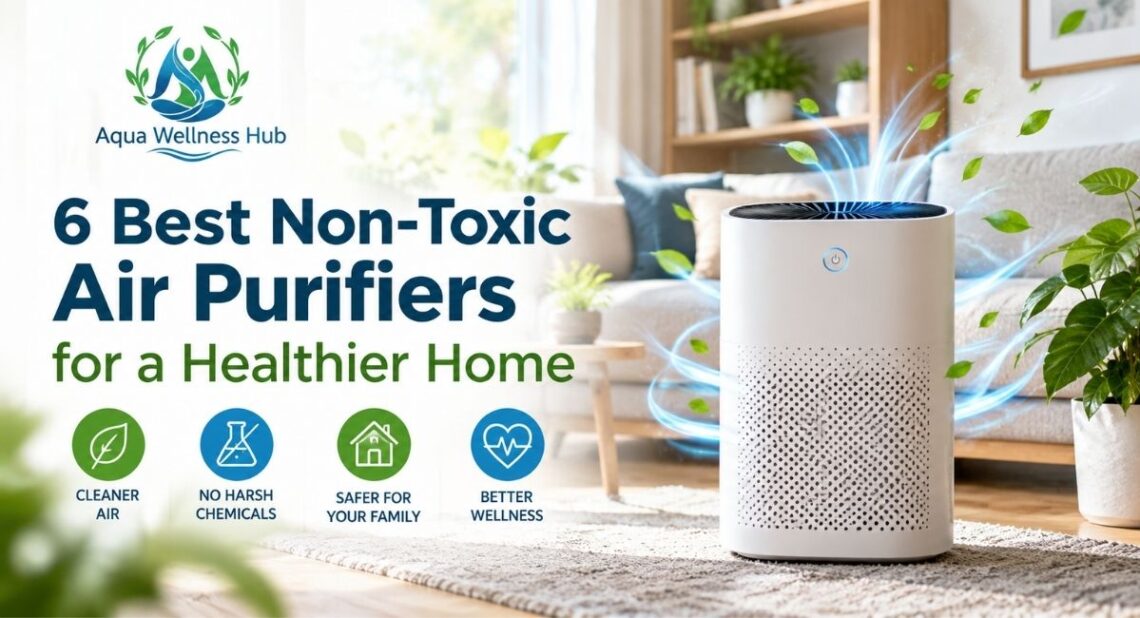
You bought an air purifier to breathe cleaner air. Then you noticed a sharp smell from the vents. Or a tingling in your nose. Or a label that said “ionizer” and “ozone” in the same sentence.
That is a bad trade. Some air cleaners fix one problem and create another.
A non-toxic air purifier does the job without adding anything harmful to your room. It captures dust, pollen, pet dander and smoke. It does not release ozone. It does not coat your furniture with chemicals.
This guide covers the six best non-toxic air purifiers for a healthier home. You will see how each one works, who it suits, and where it falls short. You will also get a plain-language buying guide, a sizing method and answers to common questions.
What “Non-Toxic” Means for an Air Purifier
No official label says “non-toxic” for air purifiers. The term is a shortcut. It usually points to three things.
It Does Not Make Ozone
Ozone is a lung irritant. Some purifiers produce it on purpose. Others make it as a side effect of ionizing technology.
The U.S. Environmental Protection Agency (EPA) warns that ozone can irritate the airways and worsen asthma. It also notes that ozone generators sold as air cleaners are not a safe choice for occupied rooms. The EPA’s guide to air cleaners in the home explains the risk in plain terms.
A good test is simple. Look for the word “ozone-free” and a certification to back it up.
It Uses Mechanical Filtration
Mechanical filters trap particles in a dense web of fibers. They do not rely on chemical reactions. A HEPA filter is the best-known example.
Mechanical filtration is easy to verify. Independent labs test it. The results are measurable.
It Does Not Add Chemicals to Your Air
Some devices release fragrance, plasma ions or reactive molecules. Some use catalysts that can create byproducts. These add variables you cannot control.
Non-toxic purifiers keep it simple. They pull air in, clean it and push it out.
Why Indoor Air Needs Attention
Most people spend the majority of their time indoors. Air inside a closed home can hold more pollutants than air outside. That surprises many people.
Common indoor sources include:
- Cooking smoke and gas stove emissions
- Pet dander and dust mites
- Pollen that enters through doors and windows
- Mold spores in damp rooms
- Volatile organic compounds, often called VOCs, from paint, furniture, cleaning sprays and candles
- Wildfire smoke that drifts inside
Particles and gases affect people differently. Some people notice nothing. Others get headaches, sneezing, itchy eyes or poor sleep.
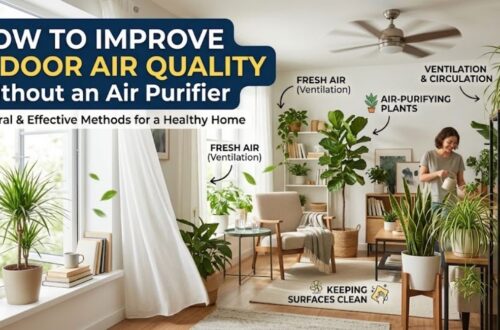
An air purifier is one tool. It works best alongside good habits. You can read more about how to improve indoor air quality without an air purifier if you want a full approach.
Key Terms Explained
A few terms appear on every product page. Here is what they mean.
HEPA Filter
HEPA stands for high-efficiency particulate air. In the United States, a true HEPA filter must capture at least 99.97 percent of particles at 0.3 microns. In Europe and the UK, filters are graded under a different standard. A grade of H13 captures at least 99.95 percent of the most penetrating particles.
Both grades are strong. Either one is a good sign.
Be careful with phrases like “HEPA-type” or “HEPA-like.” These are marketing terms. They do not promise the same performance.
Activated Carbon
Activated carbon is a porous material. It traps gas molecules and odors on its surface. It helps with cooking smells, smoke odor and some VOCs.
Carbon fills up over time. A thin carbon layer can only hold so much. Heavy gas problems need a larger carbon bed.
CADR
CADR means clean air delivery rate. It measures how fast a purifier cleans air of smoke, dust and pollen. Higher numbers clean faster.
CADR comes from tests run by the Association of Home Appliance Manufacturers (AHAM). It gives you a fair way to compare models.
ACH
ACH means air changes per hour. It tells you how many times a purifier can clean all the air in a room each hour. For allergies, aim for around four to five air changes per hour.
Ozone-Free Certification
In California, the California Air Resources Board (CARB) certifies air cleaners that meet strict ozone limits. Many brands sell CARB-certified models nationwide. A CARB listing is one of the easiest ways to confirm a purifier is ozone-safe. In the UK, look for clear statements about ozone and ionizer settings on the product page.
How We Chose the Best Non-Toxic Air Purifiers
Each pick had to meet the same basic standard:
- A true HEPA or HEPA-grade filter, or equivalent mechanical performance
- No intentional ozone production
- Activated carbon or a clear plan for gases
- Clear filter replacement guidance
- Strong owner feedback on reliability and noise
We also looked at room size, running cost and ease of use. Model numbers and availability change often, and models vary between the U.S. and the UK. Check current listings before you buy.
The 6 Best Non-Toxic Air Purifiers
1. Levoit Core 300 Series: Best for Small Rooms and Bedrooms
Levoit makes some of the most popular compact purifiers on the market. The Core 300 uses a three-stage system: a pre-filter, a True HEPA filter and an activated carbon layer. The Core 300S adds app control and voice assistant support.
Why it works: The design is simple. Air passes through all three layers in one pass. The tower shape fits beside a bed or on a desk.
Best for:
- Bedrooms up to about 200 square feet (around 18 square meters)
- Home offices
- Nurseries
- Renters who want a low-cost start
Things to consider:
- It is a small unit. Larger living rooms need a bigger model.
- The carbon layer is thin, so it handles light odors better than heavy fumes.
- Replacement filters are an ongoing cost. Levoit suggests changing them about every six months, depending on use.
The Core 300 appears on California’s certified list for ozone safety, according to Levoit. Always confirm the current listing for the exact model you buy.
For a non-toxic air purifier for the bedroom, this is a sensible first choice. It has a quiet low setting and a night mode that dims the lights.
2. Coway Airmega AP-1512HH Mighty: Best Overall for Most Homes
Coway is a South Korean company known for reliable home air quality products. The AP-1512HH Mighty is one of its best-selling models. It combines a washable pre-filter, an activated carbon filter and a True HEPA filter.
Why it works: The Mighty has strong CADR numbers for its size. An air quality sensor and an auto mode adjust the fan speed for you. When the air is clean, the fan slows down and saves energy.
Best for:
- Medium living rooms and open spaces, up to roughly 360 square feet (about 33 square meters)
- Families with allergies or pets
- People who want a set-it-and-forget-it unit
Things to consider:
- It costs more than basic compact models.
- The carbon filter and HEPA filter need replacing on a schedule. Coway offers a filter indicator to remind you.
- It looks more like an appliance than a piece of decor.
The Mighty is AHAM Verified and carries an ENERGY STAR rating, which helps with running costs. Coway lists it among ozone-safe models. As always, check the current certification.
Many reviewers name this as the best air purifier for allergies at a mid-range price. That is a fair description for most households.
3. Blueair Blue Pure 211+: Best for Large Rooms
Blueair is a Swedish brand with a long history in air filtration. The Blue Pure 211+ is built for big spaces. It uses Blueair’s HEPASilent technology, a washable fabric pre-filter and an activated carbon layer.
Why it works: The 211+ moves a lot of air. It cleans large rooms quickly. The fabric pre-filter comes in several colors, so you can match your room.
Best for:
- Large living rooms up to around 500 square feet (about 46 square meters)
- Open-plan homes
- People who want a minimalist look
Things to consider:
- HEPASilent combines mechanical filtration with a light electrostatic charge. Blueair states it reaches 99.97 percent efficiency at 0.1 micron. That differs from a standard True HEPA filter, so some shoppers prefer a classic design.
- The carbon layer is modest.
- The fan can be loud at full speed.
Blueair states that its purifiers produce no harmful ozone. The 211+ appears on California’s certified list, according to Blueair. Confirm the current status for your exact model.
4. Winix 5500-2: Best Value With Smart Sensing
Winix is another South Korean brand. The 5500-2 is a strong performer at a lower price point. It uses a True HEPA filter and a washable activated carbon filter. It also has an optional feature called PlasmaWave.
Why it works: The washable carbon filter reduces long-term cost. An auto mode reads air quality and adjusts the fan.
Best for:
- Mid-size rooms up to roughly 360 square feet
- Budget-minded households
- People who want smart sensing without a premium price
Things to consider:
- PlasmaWave is an ionization feature. You can turn it off. Anyone who wants a strictly mechanical purifier should switch it off.
- The sound level rises on high speed.
- The washable carbon filter holds a limited amount of gas. It suits everyday odors more than heavy chemical exposure.
The 5500-2 is a good example of why settings matter. The unit is solid. A single feature is what you may want to disable. Always read the manual.
5. Austin Air HealthMate: Best for Chemical Sensitivity
Austin Air is an American company based in Buffalo, New York. Its HealthMate is a different kind of machine. It uses a steel housing and a very large filter bed. The filter combines True HEPA material with a deep bed of activated carbon and zeolite.
Why it works: The carbon bed is far larger than the layers in most home purifiers. This gives it a better chance of handling VOCs, fumes and strong odors. Austin Air also builds the unit without a plastic outer shell, which matters to some people with chemical sensitivities.
Best for:
- People with multiple chemical sensitivity or strong odor triggers
- New homes with fresh paint, flooring or furniture
- Homes near traffic or smoke sources
Things to consider:
- It is heavy, around 45 pounds.
- It is not a smart device. There is no app or sensor.
- The fan is louder than many bedroom units.
- It costs more up front. The filter is rated to last for years, which reduces replacement frequency.
- It may be harder to buy in the UK. Some retailers import it.
The maker rates it for large spaces, but it works best when you put it in one main room. Treat the coverage claim as a ceiling, not a promise.
6. IQAir HealthPro Plus: Best Premium Option
IQAir is a Swiss company known for high-end filtration. The HealthPro Plus uses a pre-filter, a HyperHEPA filter and an optional gas filter set. The company states that the HyperHEPA filter captures particles down to a very small size, including ultrafine particles.
Why it works: The unit is built with sealed construction. This stops air from leaking around the filter. Leakage is a common weakness in cheaper models.
Best for:
- Severe allergies or asthma, with a doctor’s guidance
- Wildfire-prone regions
- Households that want long-term, medical-grade performance
Things to consider:
- The price is several times higher than mainstream units.
- The gas filter options add cost.
- It is bulky.
IQAir sells through retailers in both the U.S. and the UK. If your budget allows, it is a serious choice. For most homes, a Coway or Levoit does the job at a fraction of the cost.
Quick Comparison Table
| Model | Best For | Filter Type | Approx. Room Size | Smart Features |
| Levoit Core 300 / 300S | Bedrooms, small rooms | H13 True HEPA + carbon | Up to about 200 sq ft | App on 300S |
| Coway Airmega AP-1512HH | Most homes | True HEPA + carbon | Up to about 360 sq ft | Auto mode, air sensor |
| Blueair Blue Pure 211+ | Large rooms | HEPASilent + carbon | Up to about 500 sq ft | Basic controls |
| Winix 5500-2 | Value | True HEPA + washable carbon | Up to about 360 sq ft | Auto mode, sensor |
| Austin Air HealthMate | Chemical sensitivity | HEPA + deep carbon and zeolite | Large single room | None |
| IQAir HealthPro Plus | Premium, severe allergies | HyperHEPA + optional gas filter | Large room | Basic controls |
Room sizes follow maker ratings. Real results depend on ceiling height, doors and how often the unit runs.
How to Choose the Right Size
Size matters more than most people expect. A purifier that is too small cannot keep up. The air never gets cleaned enough.
Use the Two-Thirds Rule
Take your room’s floor area in square feet. Multiply by two-thirds. The result is a rough target for the smoke CADR you need.
For example, a 300 square foot room needs a CADR of about 200. This rule assumes standard 8-foot ceilings. Taller ceilings need more.
Check the Air Changes per Hour
If you have allergies, aim for four to five air changes per hour. A room that gets only one change per hour will see much less benefit.
Count Open Doors
A purifier cannot clean a room with a wide-open doorway to the rest of the house. Close the door when you can. Or choose a larger unit.
Where to Place Your Air Purifier
A good unit in the wrong spot performs poorly. Follow these simple rules:
- Leave a gap of at least a foot around the unit. Air needs room to enter and leave.
- Keep it away from corners that trap air.
- Place it near the area where you spend the most time.
- Avoid putting it directly behind a couch or curtain.
In a bedroom, put the unit a few feet from the bed. Do not aim the airflow directly at your face. A gentle flow across the room works better.
Non-Toxic Air Purifier for the Bedroom: What to Look For
Sleep is when many people spend the longest unbroken stretch in one room. That makes the bedroom a good place to start.
Pick a unit with these features:
- A quiet low setting, ideally near the sound of a soft whisper
- A night mode that dims the lights
- A size that matches the room
- No ionizer, or an ionizer you can turn off
Run the purifier on low overnight. Run it on high for an hour before bed if pollen or dust bothers you. Keep the bedroom door closed.
A cooler, cleaner bedroom helps with rest. Our guide to natural remedies for better sleep pairs well with a quiet purifier.
What a Purifier Can and Cannot Do
An air purifier is useful. It is not a cure. Honest expectations help you choose well.
What It Can Do
- Reduce airborne dust, pollen, pet dander and smoke particles
- Lower the amount of mold spores in the air
- Cut odors, if the unit has enough carbon
- Help during wildfire smoke events
What It Cannot Do
- Remove allergens that have already settled on surfaces
- Fix a mold source or a leak
- Replace ventilation
- Remove every gas or VOC, especially with a thin carbon layer
- Treat or cure any medical condition
If you have asthma or a serious allergy, talk to a doctor. A purifier supports your care. It does not replace it.
Cutting the Source: Easier Than Filtering
The cheapest way to clean air is to stop pollution at the source. This step makes every purifier work better.
Swap Out Harsh Products
Many sprays, wipes and cleaners release VOCs. Switching to gentler options helps. Try eco-friendly cleaning products that skip heavy fragrance and harsh solvents.
Rethink Scented Items
Candles, plug-ins and sprays add particles and chemicals. Many are marketed as relaxing, but they still affect the air. If you like a pleasant scent, try natural air fresheners or look at options for non-toxic candles.
Clean Smartly
Dry dusting can send particles back into the air. Use a damp cloth and a vacuum with a sealed HEPA filter. Our cleaning hacks for a healthier home cover the basics.
Ventilate
Open windows when outdoor air is clean. Use the kitchen hood while cooking. Run bathroom fans after showers. These steps cost little and make a visible difference.
Add Plants for Mood, Not as a Fix
Plants make a home feel fresher. Research on their effect on indoor air in real homes is limited. Treat them as a nice extra. If you want ideas, see these indoor plants for clean air.
Running Costs and Maintenance
Buying the unit is only part of the cost. Plan for filters and electricity.
Filter Replacement
Most purifiers need new filters every six to twelve months. The schedule depends on use, pet hair, smoke and dust levels.
Common tasks include:
- Wash or vacuum the pre-filter every few weeks
- Replace the HEPA filter on the maker’s schedule
- Replace carbon filters more often if you notice odors returning
Use genuine or reputable replacement filters. Poor-quality filters may fit badly and let air bypass the media.
Energy Use
Modern purifiers use about as much electricity as a light bulb on low settings. Auto modes lower the cost further. Running one around the clock is usually modest, but the numbers vary by model and by local rates. Pair a purifier with other energy saving devices if you want to keep bills in check.
Noise
Noise matters if you plan to run the unit at night. Compare the low-speed rating, not the high-speed one. Low speed is where you will spend most of your time.
Real-World Scenarios
Different homes need different choices. Here are three examples.
The Allergy Bedroom
A renter has springtime pollen allergies and a small bedroom. She wants something quiet and affordable. A Levoit Core 300 on a nightstand, with the door closed, suits her. She washes the pre-filter monthly and replaces the filter on schedule.
The Pet-Filled Living Room
A family has two dogs and a cat. Their open living room is about 350 square feet. A Coway Airmega Mighty fits the space. The auto mode ramps up when the dog shakes off after a walk. It slows down when the air clears.
The Freshly Renovated Home
A couple moves into a home with new flooring and fresh paint. They notice strong odors for weeks. An Austin Air HealthMate in the main living area adds a large carbon bed. They also open windows each day and let the new materials off-gas. The purifier helps. Ventilation helps too.
Common Mistakes to Avoid
Most disappointment comes from small errors. Avoid these:
- Buying a unit that is too small for the room
- Choosing a purifier with an ozone or ionizer feature that you cannot turn off
- Ignoring filter replacement
- Putting the unit in a corner or behind furniture
- Expecting a purifier to fix mold or a damp problem
- Trusting vague terms like “HEPA-type”
How to Pick Your Purifier in Five Steps
Use this short process:
- Measure your room and note the ceiling height.
- Decide how much gas control you need. Light odors need a standard carbon layer. Strong fumes need a deeper bed.
- Check for ozone-free status on the CARB list or the maker’s page.
- Compare noise on the low setting.
- Add up the yearly filter cost before you buy.
Commonly Asked Questions
What is the best non-toxic air purifier overall?
The Coway Airmega AP-1512HH Mighty suits most homes. It balances price, performance and reliability. For small rooms, the Levoit Core 300 is a strong option. For chemical sensitivity, the Austin Air HealthMate stands out.
Do HEPA air purifiers produce ozone?
A true HEPA purifier that relies on mechanical filtration does not produce ozone on purpose. Problems come from models with ionizers or ozone-based features. Check the certification and turn off optional ionizers if you want a strictly mechanical unit.
What is the best air purifier for allergies?
Look for a True HEPA filter, a CADR matched to your room and a unit that delivers four to five air changes per hour. The Coway Mighty and Levoit Core 300 are common picks. For severe cases, speak with your doctor and consider a premium unit like the IQAir HealthPro Plus.
Is a non-toxic air purifier for the bedroom worth it?
For many people, yes. The bedroom is where you spend a long stretch of time in one place. A quiet, correctly sized unit can cut dust and pollen during sleep. It will not fix every sleep issue, but it can remove one common irritant.
How often should I replace the filters?
Most HEPA and carbon filters last six to twelve months. Heavy smoke, pets or high pollen can shorten that. Follow the maker’s schedule and your own nose. If odors return, change the carbon layer.
Do air purifiers remove VOCs?
Activated carbon can reduce some VOCs and odors. The amount depends on the carbon quantity and the pollutant. Thin carbon layers handle light odors. Large carbon beds do better. Reducing VOC sources at home is still the most reliable fix.
Can I leave an air purifier on all day?
Yes. Most are built for continuous use. Auto modes reduce speed when the air is clean. Running a purifier consistently gives better results than short bursts.
Are cheap air purifiers safe?
Some are fine. Many cheap units skip certification or use ionizers and ozone-based features. Check for a true HEPA filter, a CARB listing and clear filter details before you buy.
The Practical Takeaway
A non-toxic air purifier should clean your air without adding anything to it. That means a true HEPA filter, activated carbon, no ozone and a size that suits your room.
Here are the quick picks:
- Small rooms and bedrooms: Levoit Core 300 series
- Best overall: Coway Airmega AP-1512HH Mighty
- Large rooms: Blueair Blue Pure 211+
- Value: Winix 5500-2, with PlasmaWave switched off
- Chemical sensitivity: Austin Air HealthMate
- Premium performance: IQAir HealthPro Plus
Start with your room size. Check the ozone status. Plan for filter costs. Then place the unit well and keep it running.
Take the Next Step With Aqua Wellness Hub
Cleaner air starts with small, steady choices. A good purifier is one of them. Source control, ventilation and gentler products finish the job.
At Aqua Wellness Hub, we share practical guides for a healthier, greener home. Pick one change this week. Measure your bedroom, choose a size and set a reminder for your first filter check.
NOTE:This article offers general information. It is not medical advice. Product features, certifications and availability change, so confirm details with the maker or retailer before you buy. Speak with a doctor about asthma or serious allergies.