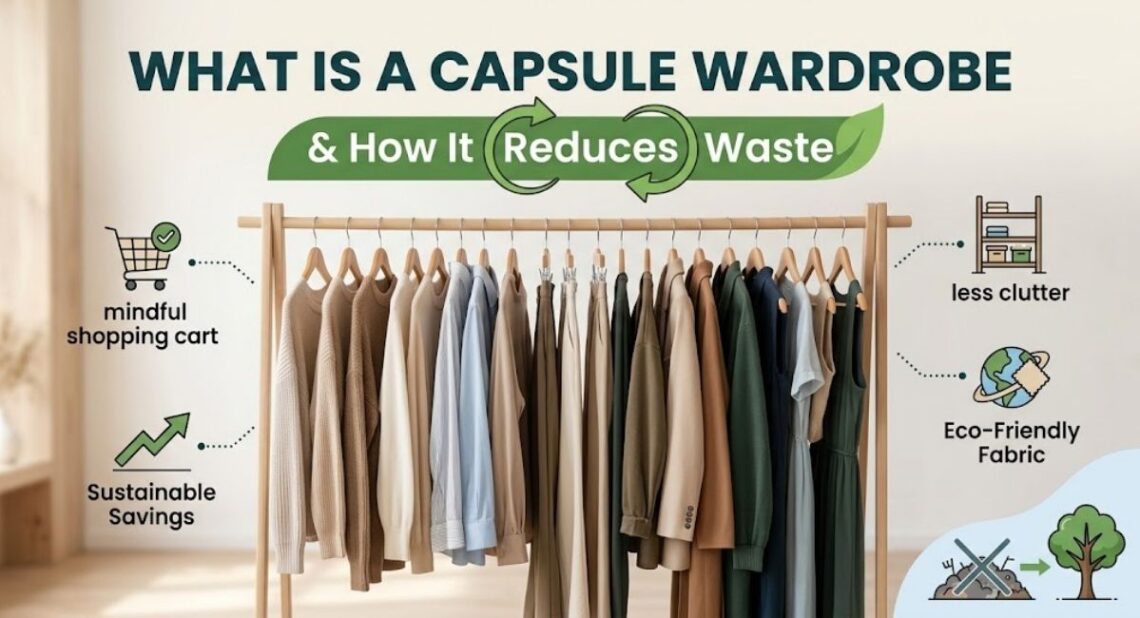
You stand in front of a closet packed with clothes and still cannot find anything to wear. It is a strange, frustrating feeling, and it is far more common than most people realize. Owning more clothing does not usually translate into more outfit options. Often it means more decision fatigue, more clutter, and more items that quietly go unworn season after season.
A capsule wardrobe offers a different approach. Instead of accumulating more, it focuses on curating a smaller collection of versatile pieces that work together, so that getting dressed becomes simpler rather than more complicated. It also happens to be one of the more effective ways to reduce the environmental footprint of your wardrobe, since it naturally slows down consumption and gets more genuine use out of everything you own.
This guide explains exactly what a capsule wardrobe is, why it reduces waste, and how to start building one using pieces you likely already have.
What a Capsule Wardrobe Actually Is
A capsule wardrobe is a deliberately limited collection of clothing, typically somewhere between 25 and 50 pieces depending on lifestyle and climate, chosen specifically because they mix and match easily with one another. The goal is not to own as few items as possible for its own sake, but to eliminate the items that rarely get worn and keep only the pieces that genuinely earn their place through regular use.
The concept traces back to boutique owner Susie Faux in the 1970s, who used the term to describe a small collection of timeless pieces that could be supplemented seasonally with a few trend items. It was later popularized more broadly through minimalist lifestyle movements, which extended the idea beyond fashion into a broader philosophy about reducing unnecessary possessions.
Importantly, a capsule wardrobe is not a fixed formula. The exact number of pieces, the color palette, and the specific items vary significantly based on someone’s climate, profession, and personal style. What stays consistent across capsule wardrobes is the underlying principle: fewer, better chosen pieces that work together, rather than a large collection of items that rarely get combined with one another.
Why a Smaller Wardrobe Reduces Waste
The connection between capsule wardrobes and waste reduction comes down to a few interconnected factors.
Fewer unnecessary purchases. When a wardrobe is built around pieces that genuinely mix and match, there is less perceived need to buy something new for every occasion, since existing pieces can usually be recombined into a suitable outfit.
Higher cost per wear justification. A smaller wardrobe built around versatile pieces makes it easier to justify spending more on individual items, since each piece will be worn far more frequently than it would within a larger, more scattered wardrobe. Higher quality items generally last longer, which reduces the frequency of replacement purchases.
Reduced decision fatigue leading to better choices. A wardrobe you can see and understand fully, rather than one so large it becomes overwhelming, makes it easier to notice gaps and genuine needs rather than shopping reactively or impulsively, a pattern we explore in more detail in our related guide on sustainable fashion swaps for a greener wardrobe.
Less accumulation of unworn items. Standard wardrobes commonly contain a significant share of items worn rarely if at all. A capsule approach directly targets this by requiring every piece to justify its place through regular, practical use.
The Building Blocks of a Capsule Wardrobe
While the exact composition varies by individual, most capsule wardrobes are built around a few consistent categories.
Neutral base pieces. Items in versatile, easily combined colors, such as black, navy, white, grey, or beige, form the foundation, since neutral tones combine with nearly everything else in the wardrobe without visual clashing.
Versatile bottoms. A small number of well fitting trousers, jeans, or skirts that pair with multiple tops, prioritizing fit and durability over trend driven cuts that may look dated within a season or two.
Layering pieces. Cardigans, blazers, and lightweight jackets extend the range of an outfit and allow the same base pieces to be styled differently across occasions and mild temperature changes.
A few statement or accent pieces. While the bulk of a capsule wardrobe is neutral and versatile, a small number of more distinctive pieces, whether a bold color, pattern, or accessory, prevent the wardrobe from feeling flat or impersonal.
Season appropriate outerwear. Depending on climate, one or two well chosen coats or jackets built for durability tend to outperform several cheaper options that wear out faster.
A Simple Framework for Building Your First Capsule Wardrobe
| Step | What to Do |
|---|---|
| 1. Audit your current wardrobe | Separate items into worn regularly, worn occasionally, and rarely or never worn |
| 2. Identify your color palette | Choose 2 to 3 neutral base colors plus 1 to 2 accent colors that already appear in your regularly worn items |
| 3. Keep the versatile favorites | Retain pieces from the regularly worn category that fit your chosen palette |
| 4. Identify genuine gaps | Note specific missing pieces, such as a versatile blazer or a second pair of well fitting trousers |
| 5. Fill gaps thoughtfully | Shop intentionally for the identified gaps rather than broadly, prioritizing quality and versatility |
This process typically takes longer than a single afternoon, and that is intentional. Rushing the audit step in particular tends to lead to premature decisions about what to keep or remove.
Starting With What You Already Own
The most sustainable way to begin building a capsule wardrobe is with an honest audit of your existing closet, rather than starting from a shopping list. Pull every item out and sort it into three groups: worn regularly, worn occasionally, and rarely or never worn. This exercise alone is often revealing, since many people discover a significant share of their wardrobe falls into the rarely worn category despite having been purchased with good intentions.
Items in the regularly worn category usually reveal your natural style preferences and the colors that already work well together in your daily life, which makes them a far more reliable starting point for a capsule palette than an aspirational color scheme copied from a style guide or influencer.
For items in the rarely worn category, resist the urge to immediately discard everything. Some pieces may simply need minor alteration, a different pairing, or seasonal timing to become genuinely useful again, connecting back to the repair and alteration principles covered in our broader guide to sustainable fashion swaps.
Common Misconceptions About Capsule Wardrobes
A capsule wardrobe means owning almost nothing. In reality, most capsule wardrobes still contain a reasonable number of pieces, typically in the range of 25 to 50 items excluding underwear, sleepwear, and specialized items like formal wear or workout clothing. The focus is on versatility and intentionality, not extreme minimalism for its own sake.
A capsule wardrobe has to look boring or plain. While neutral base pieces form the foundation, a well built capsule wardrobe includes personal style through color, texture, and a small number of statement pieces. The versatility comes from thoughtful combination, not the absence of personality.
You need to buy an entirely new wardrobe to start. The most sustainable approach starts with auditing and reorganizing what you already own, filling only genuine gaps rather than replacing everything at once. Buying a complete new capsule collection defeats much of the waste reduction benefit the approach is meant to provide.
A capsule wardrobe is only for minimalists. While the concept overlaps with minimalist lifestyle philosophy, plenty of people adopt capsule wardrobe principles purely for the practical benefits of easier outfit planning and reduced decision fatigue, without adopting minimalism more broadly in other areas of life.
Adapting a Capsule Wardrobe to Real Life
A capsule wardrobe does not need to be rigid or static. Many people build a core year round capsule of roughly 20 to 30 pieces, then add a smaller seasonal capsule of 5 to 10 pieces that rotates with the weather, such as swapping heavier knitwear for lighter layers between winter and summer.
Work requirements, climate, and lifestyle all shape what a realistic capsule looks like. Someone working in a formal office environment will need a different proportion of tailored pieces compared to someone working from home or in a more casual industry, and someone living somewhere with dramatic seasonal temperature swings will need a broader range than someone in a more consistent climate.
The goal is not to copy a specific capsule wardrobe list found online exactly, since these lists are built around someone else’s climate, body, profession, and taste. Using a general framework while adapting the specifics to your own life produces a far more useful and genuinely worn result.
Capsule Wardrobes for Different Lifestyles
The right capsule wardrobe looks different depending on daily routine, and it helps to think through your own situation rather than applying a generic template.
Remote and hybrid workers often need fewer formal pieces than in-office roles, with more emphasis on comfortable but presentable basics that work equally well for a video call and a quick errand. A smaller rotation of smart casual tops paired with comfortable trousers tends to cover most days.
Parents of young children benefit from a capsule built around washable, durable fabrics that tolerate frequent laundering and occasional mess, prioritizing function alongside style. Layering pieces are particularly useful here, since they accommodate the wide temperature range of a day spent moving between indoor heating and outdoor activity.
Frequent travelers gain the most from a capsule wardrobe approach applied specifically to a travel bag, choosing a small set of coordinating, wrinkle resistant pieces that can be mixed into multiple outfits without checking a bag. This travel specific capsule does not need to match the rest of the home wardrobe exactly, but the same principles of versatility and neutral coordination apply directly.
Students often benefit from a capsule built around durability and easy care, since budget and laundry access are frequently more limited than for working adults, making versatile, low maintenance pieces especially practical.
Thinking through which category best describes your current daily routine, or a combination of a few, helps translate the general capsule wardrobe framework into something that actually matches how you live day to day.
Maintaining a Capsule Wardrobe Over Time
Building a capsule wardrobe is not a one time project. Bodies change, styles evolve, and items naturally wear out over time, so a capsule wardrobe benefits from periodic review, typically once or twice a year around seasonal transitions.
During a review, repeat the same audit process used initially: identify what has been worn regularly, what has not, and whether any gaps have emerged. This keeps the wardrobe responsive to actual changes in your life rather than locked into a decision made months or years earlier.
The one in, one out principle is a common guideline capsule wardrobe practitioners use to maintain the collection’s size over time, where bringing in a new piece means retiring an existing one, typically one from the rarely worn category identified during a review. This keeps the total wardrobe size stable rather than gradually creeping back toward clutter.
The Financial Case for a Capsule Wardrobe
Beyond the environmental argument, a capsule wardrobe often makes strong financial sense over time. When clothing spending shifts from frequent small purchases toward fewer, more deliberate investments in versatile pieces, the total amount spent per year does not necessarily increase and often decreases, even though individual items may cost more upfront.
Calculating cost per wear, the total price of an item divided by the number of times it is actually worn, reframes the value equation in a useful way. A well made coat worn 100 times over several winters at a higher price point often works out cheaper per wear than a trend piece worn five times before being discarded. This shift in thinking, from upfront price to cost per wear, tends to naturally support better purchasing decisions even outside a formal capsule wardrobe framework, and it connects to the broader idea that sustainable choices and financially sound choices frequently point in the same direction, a theme covered further in our piece on why sustainable living is easier than you think.
Capsule Wardrobes and Mental Load
An underappreciated benefit of a capsule wardrobe is the reduction in daily decision fatigue. Choosing an outfit from a curated, coordinated set of pieces requires far less mental effort than navigating a large, disorganized closet where many combinations simply do not work together. This mirrors a broader psychological principle sometimes called decision fatigue, where the sheer number of choices available in a day gradually depletes mental energy available for other decisions.
Some of the most well known adopters of a limited, repeated wardrobe approach, including public figures known for wearing near identical outfits daily, have cited exactly this reasoning: removing a low stakes but frequent decision frees up mental bandwidth for other priorities. A capsule wardrobe does not need to go to that extreme to capture much of the same benefit, since even a moderately curated set of coordinating pieces meaningfully simplifies the getting dressed process compared to a large, unstructured wardrobe.
FAQs About Capsule Wardrobes
How many items should a capsule wardrobe have?
Most capsule wardrobes fall somewhere between 25 and 50 pieces, though this varies based on climate, lifestyle, and personal preference. There is no strict universal number.
Do I need to buy new clothes to start a capsule wardrobe?
No. The most sustainable and cost effective way to start is auditing your existing wardrobe and building around pieces you already own and wear regularly, filling only genuine gaps.
Is a capsule wardrobe the same as minimalism?
They overlap but are not identical. A capsule wardrobe focuses specifically on versatility and intentional clothing choices, while minimalism is a broader lifestyle philosophy that can extend well beyond a wardrobe.
Can a capsule wardrobe work for a family with children?
Yes, though it typically requires more frequent review since children’s clothing needs change quickly with growth. The core principles of versatility and intentional purchasing still apply.
How often should I update my capsule wardrobe?
A seasonal review, roughly twice a year, works well for most people, allowing the wardrobe to adjust to changing weather, style preferences, and wear over time.
What colors work best for a capsule wardrobe?
There is no single correct palette. The most effective approach is choosing 2 to 3 neutral base colors that already appear frequently in your regularly worn clothing, then adding 1 to 2 accent colors that complement them.
Can a capsule wardrobe include workout clothes and formalwear?
Most capsule wardrobe counts focus on everyday clothing and exclude specialized categories like activewear, formalwear, and sleepwear, which are typically managed as separate, smaller collections with their own logic.
Final Thoughts
A capsule wardrobe is less about owning fewer things and more about owning the right things, chosen deliberately so that nearly everything in your closet earns regular wear. Beyond the practical benefit of easier daily outfit decisions, this approach meaningfully reduces the waste associated with impulsive, trend driven clothing purchases that go unworn.
At Aqua Wellness Hub, we see this same principle of intentional, sustainable choices showing up across everyday life, not just fashion. To continue building habits that reduce waste and simplify daily decisions, explore our guides on simple ways to live greener every day and easy eco friendly self care habits.
Helpful resources:
– Ellen MacArthur Foundation, circular fashion overview.
– WRAP UK, sustainable clothing guidance.